Showing posts with label DSDN144_P2. Show all posts

Tuesday, May 8, 2012

DSDN 144 Project 2: Final Image Choices

I finally completed my final shoot, created the composite images, and then selected the final few that would be destined for marking. I have essentially aimed to create a series of image that works around the idea of increasing levels of traffic. We start our journey from the least busy place right through to the most busy place I could find on the day. The flows that I have been able to visualise are astonishing, and especially for the later images showing the large amounts of flow and traffic. They say a lot about us as a society.

Level 1, (Corner of Vivian St and Cuba St)


We start our journey with what I like to call Level 1. The idea with the titles is to draw a line to contemporary video games, since the style that my composite images have taken on has an almost video game feel to it. The other purpose of the incremental naming of the images is to convey the sense of an increase, which in this case is an increase in traffic and flow. 

Here, we can see minimal flow as the place I started with just isn't a very busy place. The significance of time in this shot is huge, as it reflects the temporal state of being, which is not static. The flow of people is a constant, visceral thing.


Level 2, (Upper Cuba St)


Once we progress to Level 2, we can automatically begin to see the evolution of the more static, stagnant flow into a much more pronounced, living entity of flow. Time is motion, and the people flowing through the shot show this very clearly. The element of time not existing is seen in the negative space around the people, where over time, nothing changed. The space is almost immortal in that sense.


Level 3, (Lambton Quay)

Flow has now, in Level 3, evolved yet again into something that is starting to look much more akin to a water-like motion. At present, the flow is however still relatively small, and the distance to the moving subjects is still relatively low. The shot is still a medium shot, since there just isn't enough traffic to show effectively in a larger space.


Level 4, (Corner of Cuba St and Ghuznee St)


Purely due to need to view more time essentially and capture more of the temporally active flow, the framing now switches to a medium-long shot, so that we can start to see all the people who are forming a part of the flow. The amount of people here still isn't quite enough to make an actual observation on society, however, it is still very clear seeing the way people move through time and space.


Level 5, (Lower Cuba St) 


Now is where the flow starts to really generate a real feel of depth. We get a sense of time through a non-visible space. All we can see is the change through the space over time. The people start to converge from individual swirls of light and colour into a long, sinuous river of flow. The lack of reference points in this shot really helps lose the essence of the image into the time captured.


Level 6 (Ghuznee St) 

The flow now breaks into a torrent in earnest from this shot onwards. The pure mass of people and how they move starts to meld into this unanimous being of the flow. This photo was taken at a very busy intersection, which when it goes green has an amazingly strong sense of flow through it. People know where they have to go. They have limited time to do it in, cue my perfect level 6.


Level 7 (Entrance into Civic Square)


For the final two images, I really sought to explore a place which people don't necessarily have to pass through to get to where they were going. It was a choice for them to be there. Which makes these two shots rather significant. The flow is highly adaptive to the actual people and less to the surroundings, which allows us to make a far more intriguing insight on society. People like to be close to other people. Despite them being complete strangers, this shot of time, flow, and people really illustrates that, up to a certain distance, people like to move as one. They like to be in relative proximity to each other.


Level 8, (Civic Square)

The final shot of the series, this one is also the most expressive. We see the way people in a huge crowd flow. We get to see the dynamic flow through time and space as the people join and leave the crowd. The smell of protest also lay thick in the air, and essence which I believe also contributed heavily to the actual closeness of the group. The stairs leading down into the square are immensely wide, and yet the people joining the crowd enter via a relatively narrow point, likewise with the other points of entry. The flow of the crowd through this temporal zone really allowed for some amazing composites.

This project really taught me to be much more pondering and decisive with my compositions. I was told the images had a feel of "human graffiti" to them, and looking back, I have to say I can now see it myself. Using people to paint a picture of flow through space, only without the people having a concious input into the composition. In a way, it almost feels like a little crowd psychology experiment. Maybe next time I'll add that too.

DSDN 144 Project 2: Contact Sheets / Final Shoot

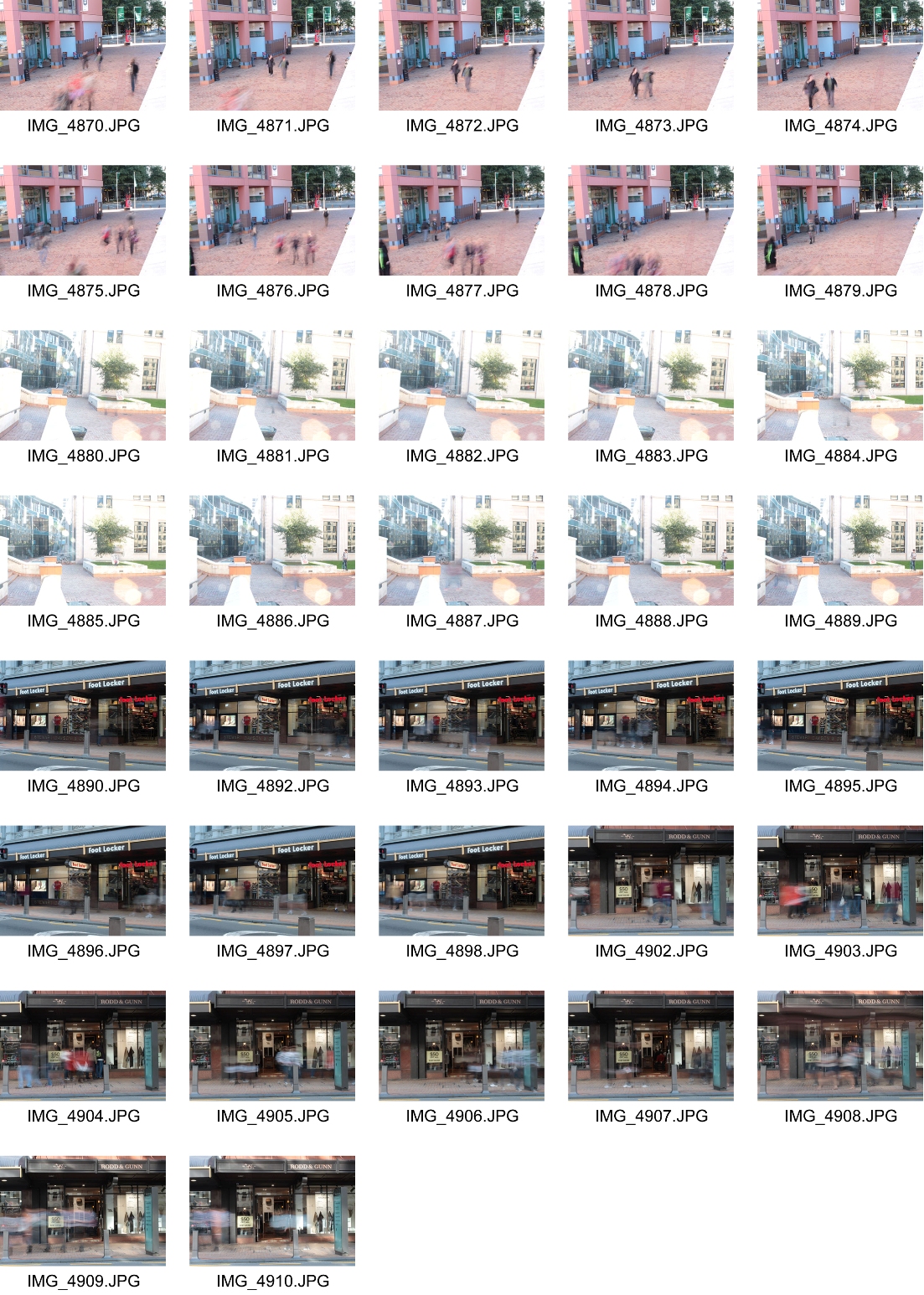
Contact Sheets for my final shoot!


Monday, May 7, 2012

DSDN 144 Project 2: Revised Revised Proposal


For the second project, the idea that that we have to portray is the idea of Time. I want to capture the movement and flow of people over time. I want to investigate the way people flow through certain places, however I want to also investigate this flow through 3-D space independently. I find it incredibly interesting seeing how people flow together regardless of the structures (or lack of them). The temporal aspect I want to investigate is how people flow over a timeless period. I want the images I create to feel like a documentation of the way people flow all the time around structures that also have no concept of time. The flow is going to be a representation of something that transcends the notion of time altogether.

For the techniques I want to use, I really want to capture these moments in a brief space of time, but I really want to show everything else, society around the man-made world, continuing to move, I want to show that the world is immortal. Since it has no concept of the passage of time, is the man-mad world not in itself immortal? I want to experiment in a variety of different places where different levels of flow and traffic can be observed. I want to show the motion of society through the 3-D space. To do this, I won't be able to just take a long exposure shot in the middle of the day, since regardless of the aperture, the image will completely blow out. Also seeing people over a long exposure, even if it were visible, would be painfully difficult, except if there were a huge amount of people. So what I plan to do is to take multiple 1-2 second exposures from the exact same spot, so that I can then combine them into a single composite image for that sequence. Amalgamating the photos will result in a much more visible flow, without sacrificing the lower light intensity.

I saw some of the ideas shown in the "time" lecture slides, and loved how some photos really just captured the moment, and I thought, "I want to distil the concept of the flow of society down to its most basic form." I think showing the way people move around a non-visible space in time would be a really interesting-but-ordinary feature, and showing that flow effectively would look phenomenal.

Ideally I want to end up with a series of photos, where the inherent idea transfers seamlessly across all the photos. The idea I have really wouldn't be suited to any kind of time lapse or stop motion, but could possibly be suited for a short video. We'll see.

Tuesday, May 1, 2012

DSDN 144 Project 2: Photo Choices from Second Shoot

So as to create the effect of flow through a physical space over time that I really wanted to achieve, I blended each sequence on Photoshop. While creating the composite images, I decided it would be really really awesome to investigate the flow of people through a space that you can't see. So, using a combination of blending techniques, I tried to generate this effect. What I created in many instances was quite astonishing. By getting Photoshop to analyse the differences in each frame, I was able to build up a picture of the change over the frames.


The difference between the frames is shown as an accumulation of colour and light. Since the only changes in the frames were really the people moving, these people show up as mysterious flows of light. The buildings around them, being static, show up significantly darker since the amount of change is next to nothing.


However, I also encountered a lot of problems with this technique. Since the technique analyses change across each single pixel, any slight difference in location of the camera makes a difference in the way the background is presented. While I did use a tripod, purely pressing the shutter button made the camera move fractionally and the background shows up, after processing the blending, as a very faint outline. Now, for some images, like the one above, this looks awesome, and really gives structure to the 3-D world the camera takes a picture of. However, for some of the other sequences, the movement was such a problem that the background shows up change-wise as bright as the moving people. The simple resolution to this problem is to simply use a remote release, which isn't a problem since I have a remote control.


I think for my next shoot, I'll experiment with purely capturing the motion over time, as well as with a small movement to capture the edges of the buildings framing the area. 
Another thing I found really interesting is that despite the diffused light from the cloud cover at the time, the shadows also register as change at the time. Very intriguing.


The continuity of the images is great too. The effect achieved isn't specific to conditions. The actual organisation of the frames makes a huge difference too, since the motion is displayed differently with different displays of "difference".


Interested to see the results from the soon-to-come third shoot...

DSDN 144 Project 2: Contact Sheet / Second Shoot

Contact Sheets from the second shoot. I shot the photos in "sequences" since I really wanted to try blending images together so that I could mitigate the problem with too little flow on short exposure images, as well as overexposure on longer exposure images.

 Contact Sheet 1

 Contact Sheet 2

Wednesday, April 25, 2012

DSDN 144 Project 2: Revised Proposal

For the second project, the idea we're to work with is the idea of Time. I want to portray the idea of timelessness of man-made structures, and the flow of society around these places/objects. The world we live in, here, in Wellington, is almost entirely constructed by humans. The roads we walk and drive on, the buildings we work in, they are all the products of our societys over-active need for progress. The world we make has no concept of the passage of time. I want to show the flow of time around and through this man-made world.

For the techniques I want to use, I really want to capture these moments in a brief space of time, but I really want to show everything else, society around the man-made world, continuing to move, I want to show that the world is immortal. Since it has no concept of the passage of time, is the man-mad world not in itself immortal? I want to see how the world flows by the places we ourselves have made. I want to experiment with a variety of compositions with the world and the "flow". Looking at the exposure time, I want to show the people still there, but not in a specific spot. I want to see the motion, I want to see the flow. So, in that respect, the exposure length will be something along the lines of 1-8 seconds, depending on the space and situation. The aperture that I want to use will have to be small, both to capture a large depth of field for the buildings, as well as to counteract the large amount of light entering the camera as a result of the long exposure.

I saw some of the ideas shown in the "time" lecture slides, and loved how some photos really just captured the moment, and I thought, "I want to capture the timelessness of buildings, the timelessness of the world around us, while we carry on about our busy lives." I think showing the way people move around the buildings in time would be a really interesting-but-ordinary feature, and showing that flow effectively would look phenomenal.

Ideally I want to end up with a series of photos, where the inherent idea transfers seamlessly across all the photos. The idea I have really wouldn't be suited to any kind of time lapse or stop motion, but could possibly be suited for a short video. We'll see.

DSDN 144 Project 2: Photo Choices from First Shoot

For the first time shoot, I very much tried to work as a solo photographer, with no-one helping me or aiding the shot. I was trying to create the effect I desired in my proposal, however, i came to realise that this simply didn't work nearly as well as I had imagined. Nonetheless, I did take some shots which I believe have potential.

The static building in the background works really well. While working with people will be a mainstay, I want to incorporate buildings more than static people. Like Alexey Titarenko, I really want to show the flow of people around the static world that we build up around ourselves. 

This was one of the few shots I was able to achieve which really had the ability to be something. The static old man on the bench really showed the flow of society around him while his life was paused as he sat on the bench. 

Waiting at a give way sign as everyone passes the car on the main road was an example that worked really well. Cars when paused, don't have a tendency to still move, unlike people. The car comes through really crisply, and we see the rest of the world in motion around it.

This car shows even more significantly what I was trying to achieve with the  flow, as one can also see the person in the car, static, while in the background we still see people on the sidewalk moving too. 

While some of the images have potential, I noticed that working with the actual physical surroundings is far more effective, and much more crisp. The people-blur around the buildings shows a much more amplified "flow", and we also get the sense of the timelessness of buildings. I have an idea to explore the flow of people and life around these buildings, these monuments that we ourselves build and exploit, while yet their lack of motion is so alien to our world. Everything moves. Even trees and plants, however, man made objects are designed to stay steadfast. Saying it like that almost seems odd.
I will be re-doing my proposal to suit this new concept.

Tuesday, April 24, 2012

DSDN 144 Project 2: Contact Sheet / First Shoot

I went and did my first experimental shoot, and this is the contact sheet.


DSDN 144 Project 2: Precedents

For this project, Time, I really wanted to find some precedents that manipulate our perception of time. I want to see how it is they can portray such ordinary things in such extraordinary ways.

My first precedent is Alexey Titarenko, a photographer who in his series "Time Standing Still" explores the hopes and dreams of the Russian people destroyed, and where time literally seems to have stopped for these people. The bleak black and white imagery portrays the people in a depressed state. His ability though to pause time for some things in his shots, but then for other things in the same shot, time continues. He really shows the flow of the people and life around singular things that don't move and for which time has truly stopped.

Taken in St. Petersburg, copyright Alexey Titarenko

Taken in St. Petersburg, copyright Alexey Titarenko


The way the people in the shot move but the buildings standing still has such an ethereal feel to it, despite it being common to see that in longer exposure shots. The black and white lends everything a timeless feel, as well as simplifying the overall information that we recieve from the image. This helps convey the sense of time much more efficiently.


My second precedent is Michael Weseley, a German photographer who does extreme long exposures to show extreme amounts of change. His shots generally extend over periods of time longer than 3 months. He chooses his locations based on knowledge of change that is about to occur. In a way, this shows extensive foresight and necessary planning, as well as time, which I simply don't have. However, his images are still very inspiring.
Taken in New York, copyright Michael Weseley

Taken in New York, copyright Michael Weseley


These photos just speak so deeply about the connection of time and space. The time it has taken to make the space what it is, the time it has taken to see the change, the time it has taken to form the photo. It all appears in these images. It's completely fascinating looking at his images, because regardless of the fact that each photo is just one photo, there is so much depth in each image. Completely awesome.


My third precedent is Chien-Chi Chang, a man whose photos usually explore the concept of isolation, alienation, but then also connection. However, a few of his shots explore time through a long exposure, showing the flow of people around the city, and through that their alienation to it.


Taken in Yangon, copyright Chien-Chi Chang
Taken in Paris, copyright Chien-Chi Chang


The portrayal of people in the midst of the city, flowing around and through the city, through both space and time is just as much what I want to portray as well. 

Wednesday, April 4, 2012

DSDN 144 Project 2: Proposal

For the second project, the whole idea of it is to capture the connection that photography has with Time. What I really want to discover, and what I've set out to do is to capture the moments in people's lives where their lives are figuratively paused. What are those moments in society where, relative to everything else, one stops moving and stops living one's life by "normal" standards. I also want to try and capture the nature of this pausing. Is it voluntary? Or are we controlled by society and told when to pause our lives?

For the techniques I want to use, I really want to capture these moments in a brief space of time, but I really want to show everything else, society around the person, continuing to move, I want to show that life only pauses for them and maybe say a few other choice people, while the rest of society goes on living. I want to experiment with a variety of times of day, but mostly have long exposure shots. 1-5 seconds of exposure. I really want to capture the person in the middle of the hubbub of society, so taking a central or rule-of-thirds viewpoint on the subject will be ideal. Keeping my distance from the object will be paramount, since ideally I want them to not know I'm there and literally stop and do their pause. Depending on the light and situation, I'll have to vary my use of aperture settings, so I'll have to see regarding that. I literally want to use the camera as a sort of "time machine".

I saw some of the ideas shown in the "time" lecture slides, and loved how some photos really just captured the moment, and I thought, "I also want to capture the moment, but only the moment for THAT person. I only want to capture their moment, and have everyone else continue on.". I think showing the everyday moments where we chose and sometimes are chosen to pause will be a really interesting idea to present, and should show everyday moments for the audience in a new light.

Ideally I want to end up with a series of photos, where the inherent idea transfers seamlessly across all the photos. The idea I have really wouldn't be suited to any kind of time lapse or stop motion, but could possibly be suited for a short video. We'll see.