

Showing posts with label Process. Show all posts
Showing posts with label Process. Show all posts
Thursday, October 23, 2014
INDN 342: Metal Returned
After many weeks of waiting for my parts to be made, they finally made their way back to me. Fortunately I was one of the first students to get my plans and design into Metco Engineering, so as a result, I got my metal back almost first. However, the delay meant that I had only a week until the final hand-in, meaning that the powder coating had to happen in the next two days so that I could get my photos and video done on the Saturday before the hand-in.
One thing that had to happen very quickly was that I had to give the insides of my metal collars a bit of a clean up in order to allow the wooden legs to fit into them. As long as I made them fit, it was all going to look good from here on out. One of the considerations I had to make was the way in which I was going to connect the legs to the metal. Since the metal was going to be powder coated, I decided to make the legs flow nicely into the metal, as opposed to having some sort of joining system that would impede the look of the stools.

Wednesday, October 1, 2014
INDN 342: Manufacturing Begins!
Now I'm in the much more relaxed phase, where I outsource everything and then stress about it not getting done. Oh wait! That's not relaxing. That's me standing in the corner of the room shuddering in fear as I mash the screen of my phone worrying about the fact that I might graduate and have no final projects to show for it. I'm not stressed. I'm mortified.
This is my de-stress and vent zone, so to all of you who actually read my blog about my path through the design-o-sphere as I come ever closer to the point of graduating, I'm sorry about that, but this month is going to be the most stressful of my life. I don't even know what's wrong with me at the moment, it's like the final hurdle I have to cross is the most difficult one. And this last one is causing me to run into so many problems I've managed to circumvent for the better part of the last three years.
Lethargy, laziness, serious procrastination, hair-pulling stress, the works. Somehow I managed to avoid a lot of that in the past three years, but now it's all piling on top of me. But I can do it! I can face the hardest time of my life and come out a stronger, better person and a designer. It's just going to take a considerable effort!
 After the reconsideration for aluminium, I went and acquired a 2.5m tube for the collars of my legs. Obviously, 2.5m is way too much for my needs, so I'll have to try and find someone who might buy some off me. The Al is really strong! I was very surprised by how intensely strong it was for the weight that it was.
 In terms of timber, I bought a fair bit of American Ash ($120 of it!) for the legs. This timber started out a little bit big, so I planed it down to size. Once I'd done that, I could start laying out the legs in the space of the timber, to prepare the legs for routing.

This is my de-stress and vent zone, so to all of you who actually read my blog about my path through the design-o-sphere as I come ever closer to the point of graduating, I'm sorry about that, but this month is going to be the most stressful of my life. I don't even know what's wrong with me at the moment, it's like the final hurdle I have to cross is the most difficult one. And this last one is causing me to run into so many problems I've managed to circumvent for the better part of the last three years.
Lethargy, laziness, serious procrastination, hair-pulling stress, the works. Somehow I managed to avoid a lot of that in the past three years, but now it's all piling on top of me. But I can do it! I can face the hardest time of my life and come out a stronger, better person and a designer. It's just going to take a considerable effort!
Once I had the aluminium tubing in the workshop, I cut it into small pieces (81mm long) to make up the collars for my legs. These pieces I then chucked on the lathe and faced them off to clean them up, after which I gave them a clean up on the inside with a burr removal tool, and then a spin around the outside ends to clean them up with a file.
Friday, September 26, 2014
INDN 342: Industrial Refinement
Now that I'm finished with the process part of this big project, I have to look forward and think about how the future of this design is going to play out. I've decided I'm going to make my stools multi-coloured, as well as also rolling with the name "The HERD stool". After talking to my tutor and lecturers about the design of the stools, I decided to ever so slightly scale the top part of the stool up and make it a little more substantial, as well as slightly altering the design of the section that attaches to the other stools.
I've worked hard to get the form of the stool just right, and the redesign of the connecting section took ages to get to the point at which I was happy with it. The design now is a little more fluid and curvaceous, juxtaposing against the relative angularity of the rest of the design. The design for that section now reflects choices to make the form useful in multiple respects.
 The animal-like character is starting to come through more and more, and a suggestion from my lecturer to make the connecting slot also have the potential to hold wine glasses was a good one. The slot is representative of a few things now and the curvaceous form is a way of showcasing that.
 And the best way for a render to show that off is of course to do a clay render! I really enjoy clay renders. They're heaps of fun and they show off the geometry really well without distorting our perception of the form with "extraneous" textures. I think I've found my new favourite way to render. I'm still nailing down the slight material settings for it in KeyShot, but I'll get it there soon.
 Today I went out to Metco Engineering after talking to my tutor. One of the most important readjustments I've done over the past morning is to actually decide to design the stool out of aluminium in stead of steel. This was done for a variety of reasons, but the most prominent was because of the weight of the stools. The steel version of the stool was going to weigh in at a hefty 12kg, while the same stool in aluminium would only weigh a mere 4.5kg. This would significantly reduce it's toddler-crushing potential if it was knocked over, as well as ensure the stools were easy to manipulate and move around.
 An area that my tutor and I differed on was about the way in which the stools should be coloured. I was adamant that I thought they should be differently coloured, while he was more of the opinion that they should all be the same. The rationale for either in the context of the "herd" is fairly sound. The first way you can look at it is to say that "each stool is identical, the same colour, hence indistinguishable from the rest of the herd".
 The second way of looking at it is to say that "each member of the herd is unique, yet from an outside looking form-only perspective, the stools are identical. They all want to be together and they like being connected to one another."
 I also think that colour would give the stools more character, while also livening up the space that the stools sit together in.
I've worked hard to get the form of the stool just right, and the redesign of the connecting section took ages to get to the point at which I was happy with it. The design now is a little more fluid and curvaceous, juxtaposing against the relative angularity of the rest of the design. The design for that section now reflects choices to make the form useful in multiple respects.
Monday, September 15, 2014
INDN 342: Constructional!
One of the things I have to consider in my design is how the whole thing works. Fortunately for me, the way I design things and consider options is always from a rather critical "will this even work" stance, which ensures that the designs I come up with have a tendency to be relatively solid in terms of construction and how they fit together. The bad side of that is of course that sometimes my creativity ends up being a bit stifled because I can shut down ideas before they have a chance to come to fruition.
 The construction drawings for this stool were really fun to generate, and I love the way that line drawings like this look. They're almost a kind of ethereal drawing, revealing hidden secrets about the design. In this instance, the area I decided to focus on for the detail was the way that the legs of the stool are connected to the actual seat construct of the seat.
 Another consideration I have to make that transcends my ability to imagine how it could quite work is the way that the forces interact on the stool. As such it needs to be broken down into it's constituent parts in order to fully understand how the forces act on each other. A loading force is applied to the stool from above, which then is spread down through the legs via rigid joints where the wooden legs are encased in metal collars. These steel collars will be welded to the stool seat, creating a really strong bond. Ideally however, the collars shouldn't experience too much force laterally in a bending direction because the legs aren't bent outwards too much. As a result, the force on the legs should be primarily in compression, not too much shear or bending.
Sunday, September 14, 2014
INDN 342: A Return To Older Forms
After experimenting with the flowing metal ribbon leg idea, I decided to move away from it back to some of the aspects of one of my original designs. One of the reasons was that the flowing metal leg would have made the stool extremely heavy. I calculated that each stool would have weighed roughly a back-straining 23kg. That's way too heavy for a stool that would only be about 450mm high and 350mm along one of the rhombus' sides.
 Another rationale for the form change was in order to give the stools the character that I spoke of previously. Somehow having the flowing metal "leg" meant that the character of the stool was kind of lost. The herding nature of the stools was still kind of inherent, but it definitely didn't feel as obvious. The little slot in the metal actually makes the stools feel more animal-like, especially when we consider the way in which certain herd animals interact with each other.
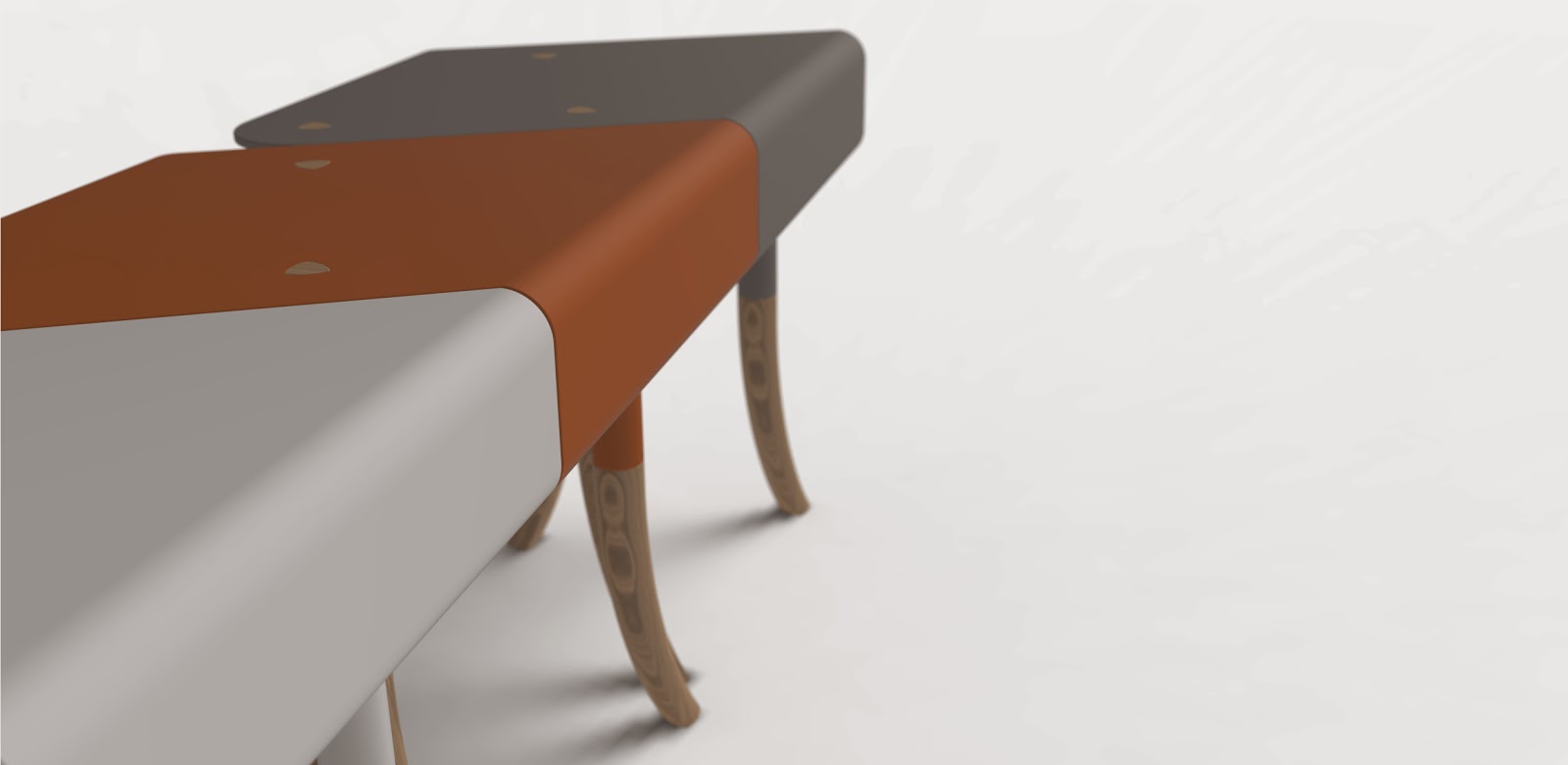 The way elephants hold each other's tails when they're on the move, and the way in which water buffalo congregate in close groups, both examples of the interaction that I'm trying to capture in this piece of furniture. When the furniture is finished (I want to make 3 stools), each stool will be able to connect to another stool in three different ways. Each stool will be identical in form, yet designed in a way to allow multiple modes of connection with copies of itself.
 The uses of the stools are designed to be multi-faceted, both in terms of implied uses through the way the stools are aligned, but also in their inherent form. Their use could easily be as side tables individually, as well as a long bench when placed consecutively, or alternatively they could see use as a collected coffee table that could be split apart to provide multiple seating or small table options. There are many configurations possible.

Thursday, September 4, 2014
INDN 342: Render Development
After playing around with the design in the sketch process, I moved into modelling my design in 3D. The modelling process allows me to explore another dimension in a very quick and aesthetic way. This is really good, especially because I can then very easily iterate on the design further and further.
 This is the first iteration of the design post-sketching. Note that the design has the fourth leg coming through the sheet metal. This started out this way in order to improve stability of the overall design, but I realised late that it wasn't very necessary. Another aspect of the design that I ended up considering more and putting some more time into was the legs of the stool.
 The legs of the stool are ultimately and actually one of the most important features of the stool design. The legs allow the stools to interlock with each other, and become more than just a stool. The nature of the stools should allow for lots of different configurations, and that's really the interesting aspect about the stools that makes me like them.
 One of the ideas about the stools that's come through recently is the way the stools feels very animal-like. One of the concepts for their quirkiness is to make them "Herd animals" and play on that idea a bit to get some more character into the designs. In many respects, the design of the stools reflects the way elephants and water buffalo interact with each other when they congregate or when they are on the move.
 The aforementioned animals often hold onto each others tails when they are on the move or when they just want to be close to each other. The concept that I'm really trying to nail with my designs is the potential for a piece of furniture to be something a little bit more living and have a bit of character and a kind of "cuteness" to them. This way the chairs could see multiple iterations and multiple uses, encouraging users to experiment and play with the configurations that the stools can be in.
 The full metal legged stools toy with the concept of having a single flowing "ribbon" of metal, as opposed to a potentially top-heavy design that might possibly not make a flowing contiguous connection to the ground it sits on. The design above looked at how an angle could possibly make the flow of the of the stool design a bit different.
 This design looked at creating a another section of usable space, enabling the user to really utilise the spaces created in more obvious ways. This one could be a really cool design, however after considering the design a little bit, I realised that the design might allow the metal side to act as a spring, making it flex and bend a little more than it should really be allowed to do.
Friday, August 29, 2014
INDN 342: Sketched Development of the H-03 (Temporary Name)


However, that's when I realised there was a problem with the straight slot. While it works really well for simple connections, such as the top and bottom red hatched sections, it posed a big problem for the main feature of the design, namely the ability for the stools to be slotted together as one big three-piece table.


Monday, August 25, 2014
INDN 342: New Sketch Models
The sketch modelling process is an important aspect of my design process, however I'd still argue that I'm very good at making decent sketch models. However, I think that the ideas and concepts are conveyed quite nicely through the models that I do make. And really that's where the importance is for me personally. Ultimately in this project I want to make something that I'm going to enjoy having and enjoy looking at. Those are factors that might not be directly inherent right now visually, but just might come through in the perceived function.
 This stool type explores a very simple principle and could be expressed quite nicely through a form that was highly expressive of the materials it was made from. The materials themselves could kind of inform how the process might work. This particular concept could be made of plywood or laminates, and the bend could be controlled by just laminating or steam bending the section.
 Each piece on it's own has a small lower section where users could put down their coffee, perhaps their book, or a multitude of other small- to medium-sized items. The form of the design also informs how it's put together, as well as allowing for potential play with how the two identical stools interact with each other. This form is basic, but the design could be expressed in a very linear, geometric way, as well as a more curvy form.
 This design definitely tracks down the more geometric path, as it looks at a equal-sided rhombus for the main form. I actually really like the shape that this design creates, and the way it makes sense in terms of construction. It feels like a simple folded steel construct, and that is then emulated in the way that the bottom section of the stool sticks out to provide both a "locking" point as well as a place to place and keep small items.
 After playing around with the basic sketch models, I realised that a really nice way of joining these stools up together was to arrange them in a hexagon, joining the three different stools up rotationally. This was because of the 30 degree rhombus that I chose as my form. It allows for perfect matching up with the next stool. The rationale behind three stools comes from the way they can be arranged. When arranged as three, they make a really cool shape for a coffee table.
 The forms slot together really nicely, as well as complementing the shapes of the other. Construction and manufacture of these should be fairly easy, as the design is the same for each chair. The way that each chair is expressed is where the interesting thing lies, allowing the chair to be harmonious with the rest of it's design, and allowing for lots of interesting configurations.
Sunday, August 17, 2014
INDN 312: 3D Printers In Every Home
The project that I've been developing in this class focuses heavily on the potential of the 3D printing revolution. I'm looking at how this revolution could impact smaller towns in New Zealand. This culture is one which New Zealand's history is heavily steeped in. Small towns formed the basis of our western cultural heritage, often being based around specific resources or commodities that were made, mined, or harvested there. These towns now form the backbone of our agricultural sector, with most farmers using the small towns as their closest port of call for almost anything.
 The small town is sadly also seeing a slow demise. The rural-urban shift is a very real global trend. This spells disaster for those who depend on their home town for their livelihood. The reality is a lot of people end up moving to the city after being faced with job difficulties in their home time, therefore further perpetuating the cycle. No one is to blame for this of course, the cities often bring much more excitement as well as more people into people's lives that they might have missed out on otherwise.
 The issues that face small towns could possibly be dealt with in part with certain active responses. The opportunities that I see involve using 3d printing as a method for creating new jobs, new opportunities, and new life in a small town. Perhaps by allowing the town to retain and sculpt its own identity, it might encourage more people to engage and stay in their communities. New life could be injected into these townships, and the youth of the towns might be able to find creative outlets for their free time and isolation from the cities.
 A concept that was suggested was the potential of letting the towns develop and create a scape that that the big cities don't have. Encouraging technological progression in the small townships could legitimise the towns as a place to stay and live for uncertain people. The utilisation of new technologies would allow the town to develop a progressive cultural and social identity. Using Scion's cellulose-based 3d printing material as well as developing their manufacturing techniques into a system that would allow more more independence from the larger cities, as well as creating an almost self-sustaining system.
 3d printing being such a new and minimally adopted technology means that there are definitely going to be some barriers to its widespread adoption. This is almost consistently the way with new, game-changing technology. Hopefully the development of the technology and the acquisition of it into the homes of many would be accelerated with the presence of the internet and the global economy. The ability for everyone to design their own 3d printed objects might be a little much for now, but the potential is that soon 3d modelling knowledge might be as commonplace as knowing how to use a computer. At the very least, the hope is that the basic skill set of 3d printing; utilising it solely as a printer of available designs, would be widespread.
 The way that this could be engaged with a small town presents a unique challenge. The idea that this could be a holistically designed system of products and services is an attractive one. But, that said, how would I, a single person accomplish that in such a short time, considering time is running out? The answer would usually be I'd try my damn best, but given that this is one of my last project, I want it to be a really good one. A really good one. That means that I think I need to take a more realistic and considered approach to the project and what it might mean and how it can then be extrapolated and made awesome. More to come soon!
Friday, August 15, 2014
INDN 342: Sketch Development
The sketch development for my furniture design project is a very long and at times arduous, but I'm really enjoying the amount of development I'm getting the chance to put into my projects. The project is very much still a mixed bag in terms of my direction for it. I'm worried about working on the project and then reaching a point where I've made a bad call and just have to roll with the design. I'm rather worried that I won't be completely pleased with the result of the furniture.
 I have lots and lots of ideas floating around in my head, but I'm concerned that the ideas just aren't good enough. I know what the ideas are based around in terms of what I want them to do and how one interacts with them, but at the same time I also want to find a design that I really want to pursue. And I want to find that idea soon.
 The two ideas that I'm developing at the moment are based around the same basic concept. I want the stools to interact with each other in a way that allows them to come together and form one single piece of furniture. This piece of furniture may form the same function as the previous two separate components, or it may fill an entirely different function. The first iteration of that idea looks at the way two stools could come together and interlace to still form one single stool, by way of the way they are designed.
 The second idea that I initially pursued, but am no longer looking at, analysed the notion of the perfect fit and how it could be expressed in a pair of stools. The stools wouldn't be the same height, but would look at how the user might interact and play with the stools. The stools would fit on top of each other perfectly, the molded form of the top one sitting perfectly on top of the seat of the lower one.
 The method of interlacing proved to be very challenging, as the design obviously would have to come apart, meaning making two identical stools that would slot together in the way I desired was almost impossible. I have a mind for manipulating things in 3D, but this unfortunately was a little beyond me. The interlacing was a really fun thing to work with however, and offered both an interesting challenge as well as a lovely rhythmical approach to the forms that the other design concepts didn't.
 The third concept that I looked at started out with a look at the Yin/Yang symbol, and how both parts are actually identical, yet they slot together in a way that isn't inherently simple or linear. This sparked the concept for a third design, one that looked at the different ways a set of identical stools would be able to fit inside, above, and below each other, all at the same time.
 The design that I presented at my presentation for the final idea was seen as the design that offered the most potential, whereas the other two were more implicit in the way they fit together. This one had the most potential for surprise, as well as the ability for capturing the "!" moment that I really liked about Nendo. The way the surprise could be conveyed could be very dependant on the way that the stools fit together, or it could be based on the material selection, and how everything works in terms of materiality.
 The way that I looked at the stools allowed for the design to progress in a very linear way. Now that, that right there is really damn boring. I want to break the mould for this project. I want to be able to make something that really stands out and creates a unique silhouette or has a certain uniqueness of character. Something that gives it that wow factor and makes it have a certain effect on the people that see it.
Tuesday, August 12, 2014
INDN 342: Nendo, Chair Bonanza!
Nendo has a really fantastic concept that they try and convey in their designs. This notion is the idea of trying to bring a "!" moment into the everyday life of the viewer/user.

Image acquired from: http://www.nendo.jp/en/

Image acquired from: http://www.nendo.jp/en/
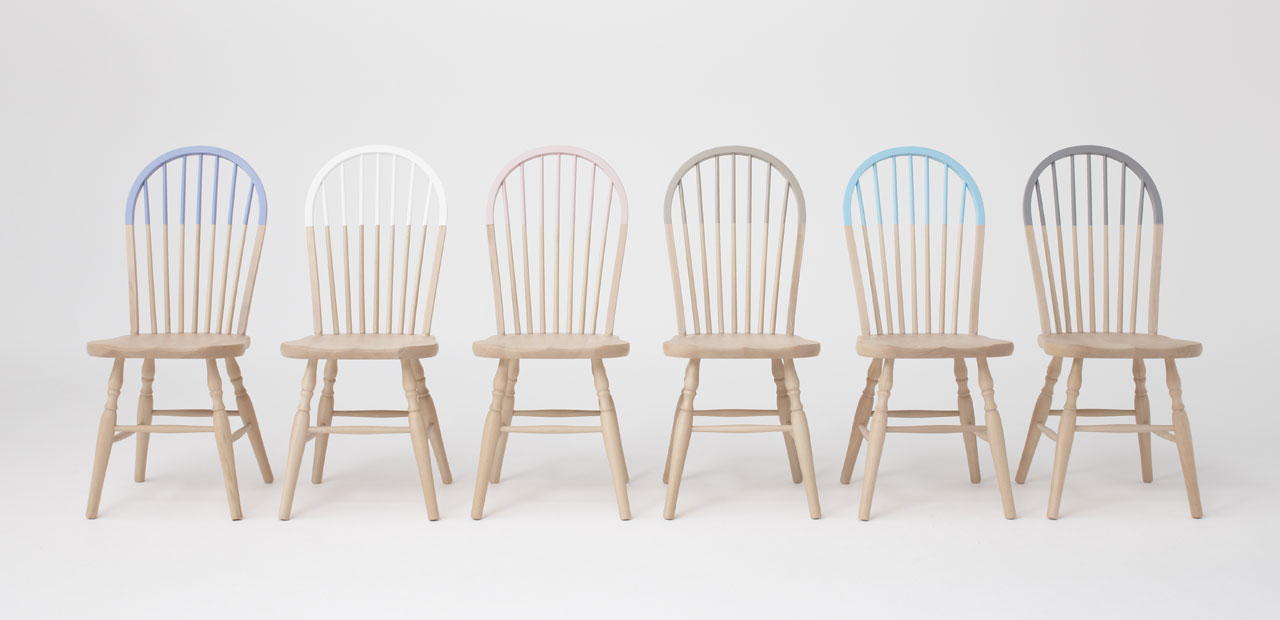
Image acquired from: http://www.nendo.jp/en/

Image acquired from: http://www.nendo.jp/en/

Image acquired from: http://www.nendo.jp/en/
I'm a huge fan of Nendo's furniture designs, as a lot of them really connect with my ideals in terms of the way that things could be designed.
Subscribe to:
Posts (Atom)