Since I'm meant to have 3 branches to my design tree, I figured I should probably start a new branch by now. For the next branch, I'm going to again look at an iterative form that is used over and over again, but this time the form will be one that is much more about the collective than about the individuals making up said collective.
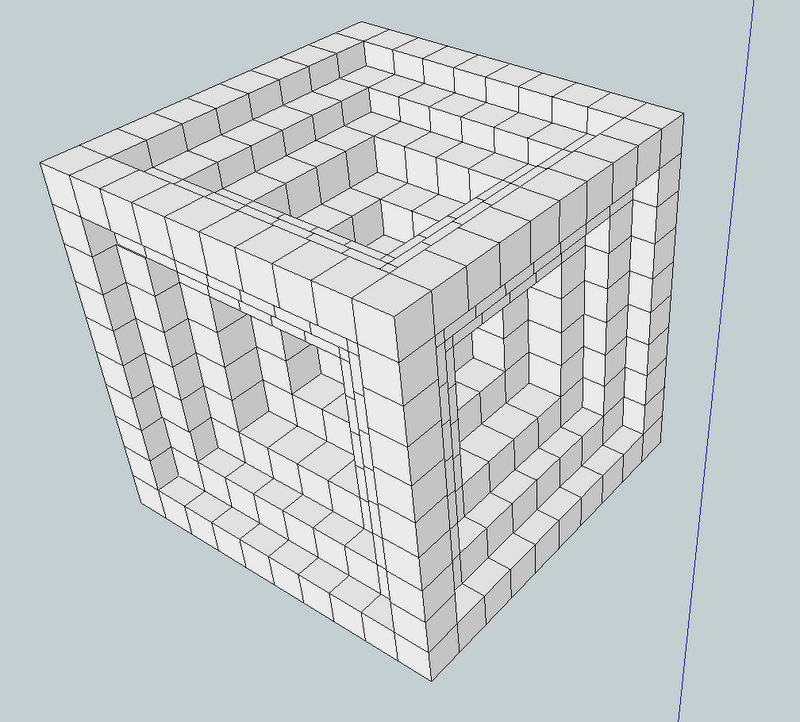
The cuboids making up this shape are each 3*3*3mm, so there are 1000 of them. That's a huge amount of cubes. Well actually in this one it's technically less, since some of them have been removed to make the form.
It's a rather fun form, and I enjoyed making it. The way it could possibly look done in chrome would be amazing. I just like the look of it. It's simple, it's geometric, and it works. It goes well with my concept of iterative design for this branch.
And the render looks fantastic! I love rendering, and I think I'm starting to get really good at it, no?
Monday, October 1, 2012
DSDN 104: A Hexagonal Staircase...
The next design that I created for the hexagons branch of my design tree focuses much more on the internal space of the model rather than that exterior form. The whole central structure is aligned to the outer hexagon that makes up a frame and wall of sorts, which allows the internal structure to be formed.
This design almost feels like it could be something architectural, focussing on the internal development of the space as a whole. Spiral staircases anyone? Could be something off Hogwarts.
The braces across the middle are to enhance the internal structure as well as brace the outer walls against damage.
One of the really cool things I found about this model was its wireframe in the side on view when it was imported into 3dsMax. I love the symmetry about this model, and the way that despite the lack of an external structure per se, the model is still intricate in its own special way.
Interestingly, this model actually rendered really well. The chrome makes the internal structure reflect heavily and show most of the surfaces twice, which I think is really cool. The internal structure makes the model feel really special and precious, and in a way reminds me of a geode. The outside is plain and boring and it looks like any plain old rock, but when you open it up, that's when the true majesty of it is revealed.
DSDN 104: More Hexagonal Work...
So I kept on moving forward with the hexagonal designs. The ideas that I came up with stemmed mostly from relatively random creations at time. But they're designs in their own right and have the right to survive to be reviewed.
I worked heavily in Sketchup again, mostly due to the lack of Solidworks at home. Just because I have a less powerful tool at my disposal does not however mean that my work would suffer. In fact, sometimes much stronger aspects can come out in full where as sometimes the over-use of powerful technology can dull that lustre.
The second design in the branch of hexagonal iterative designs is what I've decided to call the Hexa-Reactor, which is composed of 35 hexagons arranged in what I'd almost deem a very peculiar way. There is a central series of hexagons around which the others are arranged. On every layer, three of the hexagons are arranged vertically, while the other three are arranged horizontally. It looks really unique!
The view into the reactor core, end on showing the design of each layer.
Here we can see the Hexa-Reactor in all its Sketchup glory. For a free tool, Sketchup is pretty damn awesome!
Here I had a lot more fun with the rendering again. I know it's a bit questionable, but I wanted to create the sense of something potentially sinister and powerful, just like a reactor.
In stark contrast, the chrome finish gives the Hexa-Reactor an expensive, almost ethereal look. The blank, markless faces of the forms gives that sense of something untouchable, something that could possibly not even be of this earth.
For that model I then jumped back a little bit to model number one, when I was trying to get something complex out of an iterative shape. I went for creating the sense of flow again, however aimed to keep the shape a lot more compact for this piece. Another element that I wanted to include was the central triangle that carries all the way through the shape.
Here you can see all the hexagons arranged vertically, very clearly showing their structure while the triangle down the middle gives the shape a clear core form.
Here you can see the actual shape of the model very clearly. I actually really really like this model, as it very clearly shows the curve I was trying to achieve, while the shape remains very compact and controlled, while still allowing for the iterative design to shine through.
Again, I rendered in chrome, but not in glass this time. The chrome almost makes it seem like an intense piece of small machinery. Can you imagine having a 3-D printer in the shape of this? How impractical. The design wouldn't suit at all. The shape does look really cool in the chrome though.
DSDN 104: Modelling The Hepta-Knot
Again, I started out by purely sketching out the design. At first glance it looks very similar to the Penta-Knot, and while that isn't wrong, it is many many times more complex to construct.
Building this guy on Solidworks was an absolute nightmare. The angles I was working with were insanely precise and had to be, otherwise nothing would have matched up. In the end though I did get a result, and it looks good.
This model is another twig on the branch that is my constructed knots. They're tough and time consuming to make, but damn are they fun to look at. I also had a lot of fun with rendering this one. After doing some more work looking at precedent materials, I decided to render these guys in chrome and glass, in the same position.
Interestingly the effect is profoundly different in each render. The first one feels like something off an anime for some unknown reason. I think that's probably due to the start contrasts and lack of colour. The chrome almost feels like it has a life of its own.
Sexy chrome renders are sexy.
The glass render is more more static and yet not at the same time. It's quite odd how different renders manage to achieve a collection of two different things, despite the fact that the model and positioning hasn't changed at all.
Subscribe to:
Posts (Atom)