Sunday, April 14, 2013

INDN 211: The Seed

Woah. It's over. That was an amazing project, most importantly from a purely learning perspective. I learnt so much about things I had no prior knowledge about. My work found a direction, it found a style, and it found a form.

The idea behind my project is a gift aimed at a corporate culture. The proposition of a relationship is an extremely important gesture in business circles, and can lay the foundations for multi-million-dollar partnerships. The concept of my idea is that the gift embodies a suggestion of growth and transmutation, both through its form and its contents, inspiring the receiver to nurture both the plant and the new relationship. Inspired by the form of a seed and containing two New Zealand Natives, The Seed is a contemporary expression of a high-class NZ corporate gift.

A simple interaction.

 Yielding beautiful results.

 In any location.

I'm really pleased with how this project turned out. The way I overcame faults allowed me to further expand on my culture of NZ-based corporate culture. The swamp totara I ended up using for the top segment was apparently over 2000 years old, allowing to me build a piece of New Zealand history into my piece. This for me really allowed my piece to become something very corporate and special. Staining the wood, but allowing its grain to shine through really allows the gift to be high class, while still holding onto its roots and maintaining a clear connection to the natural world.

Friday, April 12, 2013

INDN 252: Integrated Designs!

So now that I have a direction for my form, I can start working on the design of the form itself. The direction that I want to take with my form is one of futuristic lines and graphic elements that all form together to make an overall joint structure.

This joint design will draw most heavily on the piece of architectural conceptualisation from Mass Effect, as I found the clean lines and overall forms worked the best for me. I want to base the form on straight parallel lines, with a mixture of diagonal 45 degree lines built into the form. To complement  and complete these lines, I want to also use curves that will follow the lines and complete them, but (aside from the central axis) not be any separate entity on their own.

The sketch below is my starting point, and the final sketch is my finishing point for the sketch. I'll let the images do the talking.

Now that I've got a form to work with, I could start coming up with how I was best going top structure the form with correct sizings. This resulted in the sketch below, wehre I figured out a lot of my dimensions. This sketch is by no menas to scale, so the form may still change in dimensions significantly, so that form and size is not the final size by any means.

A bit of a mess, I know. But it works for me and will help maintain an overview when I create my piece in Solidworks.

Wednesday, April 10, 2013

INDN 211: Reaching a Conclusion

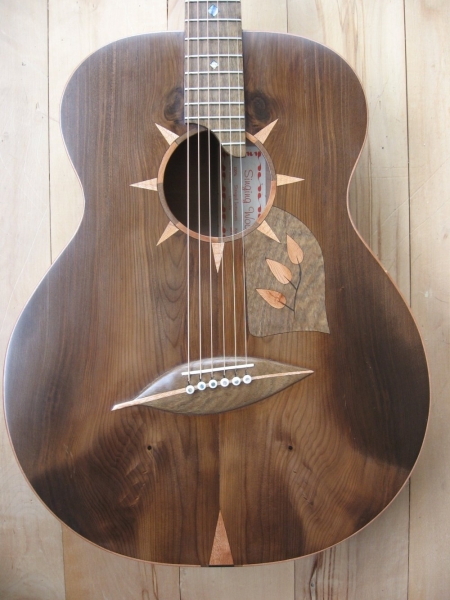
I've finally come up with a concept for how I'm going to finish this project. I stumbled across a few random pieces of wood today, and found out they are actually from a NZ native tree, known as a swamp totara, which is a tree often dug up out of old, burnt swamps. The wood is reasonably prized, so finding a random little piece of this and then discovering what it was is a bit of a joy.

Image acquired from www.singingwood.co.nz

The image above is a swamp totara guitar, made buy an NZ artisan by the name of Ian Davie. The wood is a rather nice dark colour, however, for it to work with my project, I want to stain it much darker, to an almost black colour. I'm going to do this with watercolours, as this will still allow the grain to shine through.

A suggestion by one of our epic workshop guys was to also oil the wood afterwards, as this would give it a sheen, as well as allowing the wood grain to show through even more.


I formed the top section out of a single solid cube of wood (like the one the shape is sitting on), slow bit by slow bit, mostly on the belt sander, before finally finishing it by hand. The shape of this piece means that the top fits really well, and snugly covers the whole of the top side. This is a far superior piece to the metal piece that I had prior!

Now that my piece is finished, It's time for photos!

As follows are a few of the best:


Tuesday, April 9, 2013

CCDN 271: Assignment Two: Identifying a Standpoint & Support


The influence Critical Design enforces over Affirmative Design and its actual validity as a true game changer is, in my opinion tenuous, at best. With Affirmative Design propped up by both the capitalist and consumerist worlds it would seem improbable that Critical Design could harness enough momentum to topple such a well-established and well entrenched stronghold in the market place.

The essay will argue that Critical Design has little capacity to instigate massive change. Critical Design is unable to lead with consumable examples and at best only challenges the status quo with provocative questions and ideas. I will assert that for change to really happen, it has to be generated through popularity - affirmative processes that effectively change the status quo, not challenge it. This essay asserts that big corporations truly hold this sort of power, as suggested by Linn & Hayman’s article Can Big Businesses Make the World Better While Making Money? This essay contends that Critical Design should not be acknowledged or credited with anything other than complex strategies for suggestion.

Starting with Klaassen & Neicu’s paper CTRL-Alt-Design, this essay will look at the concept of open design; where product design is outsourced to the consumers themselves, the designers having to relinquish control, allowing for a maker society where rather than selling products, the corporations sell the means to make the products. This essay will also look at how design as a practice has been affected, but not truly changed, by Critical Design. It will also look at how Critical Design is too inwardly focussed to create a noticeable grassroots effect, as supported by Yauner’s investigation Can Critical Design Create a Debate, if it just keeps Talking to Itself?.

Nominating Massive Change as the intersecting theme, this essay will look at the global impact created by an evolving culture of design and the design method; supported by Melles & Feast’s research Design Thinking and Critical Approaches: The Pragmatist Compromise, as well as Coughlan’s article How Might Design Catalyse Massive (Positive) Change?, where the design theory is given an increasingly different role in a changing capitalist world with respect to consumers and producers. It will provide a valid critique of Critical Design in a world dictated by consumers and powerful corporations. The essay will also seek to understand why Massive Change occurs, and what corporations have influenced the world of design to instigate said Massive Change. The primary text I will use is Massive Change by Bruce Mau and the Institute without Boundaries.


Bibliography

Barab, S. A., Thomas, M. K., Dodge, T., Squire, K., Newell, M. (2004). Critical Design Ethnography: Designing for Change. Anthropology & Education Quarterly, 35(2), 254-268. doi: 10.1525/aeq.2004.35.2.254

Coughlan, P. (2010). How Might Design Catalyse Massive (Positive) Change? The Journal of Corporate Citizenship, (37), 34-36. Retrieved from http://search.proquest.com/docview/497142247?accountid=14782

Klaassen, R., & Neicu, M. (2011). CTRL–Alt–Design. In Proceedings of the Design History Society Annual Conference Design Activism and Social Change.

Linn, R. & Hayman, J. (n.d.). Can Businesses Actually Make The World Better While Making Money?. Co.Exist. Retrieved from http://www.fastcoexist.com/

Mau, B. & Institute without Boundaries. (2004). Massive Change. London, U.K.: Phaidon Press.

Melles, G. & Feast, L. (2013). Design Thinking and Critical Approaches: The Pragmatist Compromise.

Yauner, F. (2012). Can Critical Design Create a Debate, if it just keeps Talking to Itself?. Retrieved from http://www.northumbria.ac.uk/